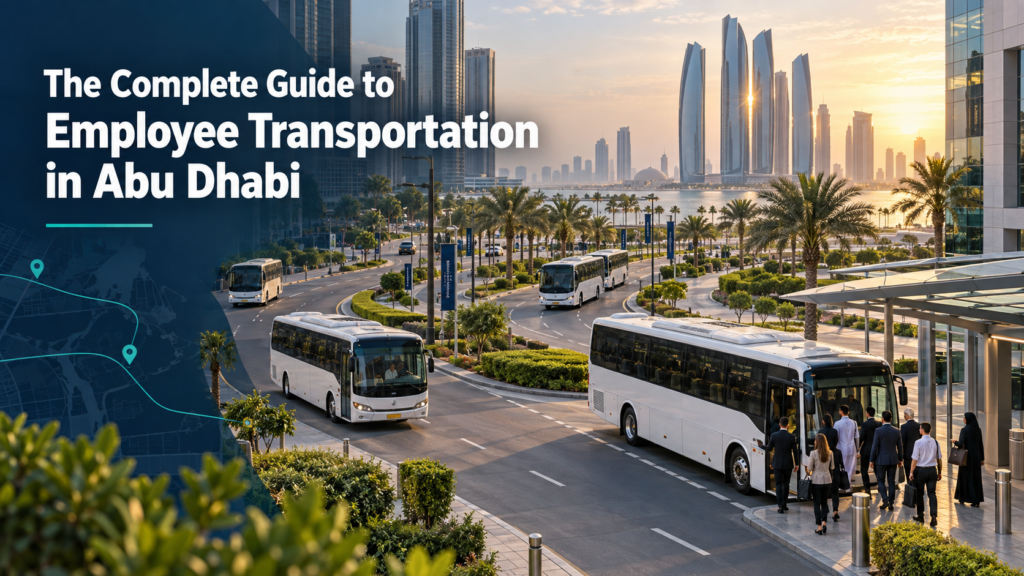
Abu Dhabi’s workforce doesn’t live next door to the office. Staff commute in from Mussafah, from residential towers on Reem Island and Khalifa City, and increasingly from Dubai and Sharjah as rents rise. For most businesses, that means employee transportation isn’t a perk anymore — it’s how you actually get people to work on time.
This guide covers what to look for when setting up employee transportation in Abu Dhabi, and where most companies get it wrong.
Why Abu Dhabi Employee Transportation Looks Different
Abu Dhabi isn’t Dubai. The city spreads across islands and industrial zones, and a large share of the workforce sits in government offices, oil and gas operations, and industrial areas like Mussafah. That geography creates a few specific challenges:
- Longer average commutes. Many staff travel from Dubai or Sharjah, which can mean an hour or more each way.
- Shift-based movement. Industrial and energy sector employers often run multiple shifts a day, not a single 9-to-5 window.
- Mixed pickup zones. One workforce might include staff from five or six different residential areas. It needs careful route planning to avoid half-empty buses.
A transport plan built for a typical Dubai office commute usually doesn’t hold up under these conditions.
What to Look For in an Employee Transportation Provider
Before signing a contract, check these points:
- Route planning based on real traffic, not map estimates. Abu Dhabi’s bridges and industrial roads get congested at predictable times. A good provider builds the schedule around that.
- GPS tracking on every vehicle. This lets your HR or facilities team verify pickups and manage delays as they happen.
- The right vehicle mix. A 14-seat van suits a small executive team. A 50-seat coach suits a Mussafah plant with hundreds of staff arriving on the same clock. Most contracts end up using two or three vehicle sizes together.
- Licensed, passenger-trained drivers. Confirm the driver holds the correct UAE licence category and has training specific to passenger transport, not just a standard driving licence.
- A named account manager. Shift changes, new joiners, and last-minute route adjustments happen constantly — you want one point of contact, not a call centre.
ICR’s staff transportation service is built around exactly this: dedicated buses, GPS on every route, and one monthly invoice covering the whole fleet.
A Real Example: Abu Dhabi City to Mussafah
One of the most common employee transportation corridors in the Emirate runs from Abu Dhabi city to Mussafah — a roughly 40-minute trip that carries a large share of the industrial and manufacturing workforce every morning. Getting this route wrong doesn’t just cost time. On a shift-based site, a bus that arrives 20 minutes late can delay an entire production line.
This is why route planning matters more in Abu Dhabi than almost anywhere else in the UAE. A provider that understands local corridors — not just the shortest distance on a map — is worth paying for.
How Employee Transportation Is Usually Priced
Cost is set per vehicle, per month, based on:
- Number of seats
- Distance covered
- Number of shifts per day
- Whether the bus is dedicated to your company or shared with another client
Most providers can give a firm monthly figure once they know your staff locations and shift times, rather than a rough estimate.
Short-Term and Project-Based Options
Not every business needs a year-round contract. If you’re mobilising a new project, covering a seasonal peak, or relocating an office, short-term hire with vehicles and drivers for a defined period is usually available — without committing to a long-term agreement.
Frequently Asked Questions
Is employee transportation mandatory in Abu Dhabi? It’s not a blanket legal requirement for every industry, but many labour and industrial employers are expected to provide safe transport for staff as part of standard workforce welfare practices, and it’s become a common expectation across office and industrial sectors alike.
Can one provider cover both Abu Dhabi and Dubai commutes? Yes. Since many Abu Dhabi-based staff live in Dubai or Sharjah, look for a provider that already runs inter-emirate corridors rather than treating Abu Dhabi as a separate, standalone service.
How far in advance do we need to set up a route? Most providers can move from an initial staff list to a live route within about a week, including a trial run before the service officially starts.
Can routes be changed after the service starts? Yes. New joiners, leavers, and shift changes are normal — a good provider reissues the route sheet within a few working days of any change.
Final Word
Employee transportation in Abu Dhabi has to account for longer distances, industrial shift patterns, and mixed pickup zones that don’t exist in the same way elsewhere in the UAE. Getting the vehicle mix, route planning, and driver training right from day one saves far more than it costs. If you’re setting up or reviewing staff transport for your Abu Dhabi workforce, talk to ICR about your shift times and pickup locations.