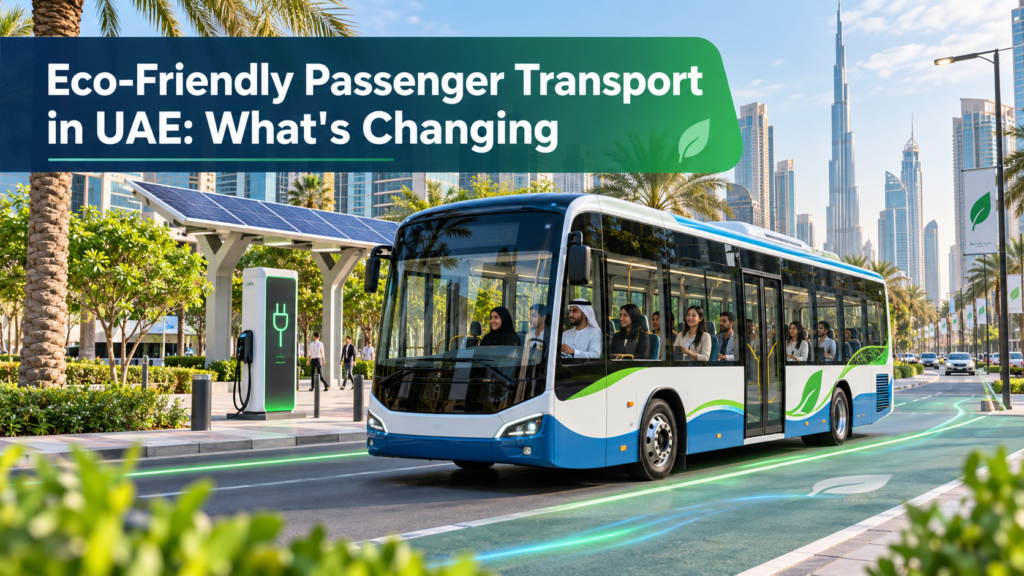
Shared transport has always been greener than everyone driving alone. But eco-friendly passenger transport in UAE is starting to mean something more specific than that. The country is pushing toward its net-zero 2050 targets. Transport operators are rethinking fleets, routes, and daily operations as a result — with sustainability as a real design goal, not just a marketing line. Providers running large-scale passenger transportation networks across Dubai, Abu Dhabi, and Sharjah sit right at the center of that shift.
Why Shared Transport Was Always a Head Start
A single bus carrying 50 passengers replaces roughly 40–50 individual car trips during peak hours. That math alone makes buses and shared vans one of the most effective tools cities have. They cut per-person emissions, congestion, and fuel use, and nobody needs to change their destination or schedule. Group transport for schools, staff, and events builds on this same logic at scale. That’s part of why group travel bus rental has become a practical sustainability lever for companies and institutions, not just a convenience.
Fleet Choices That Actually Move the Needle
Beyond simply filling seats, several fleet-level choices meaningfully reduce environmental impact:
- Newer engine technology with lower emissions standards, phased in as older vehicles retire from the fleet
- Regular maintenance schedules, since a well-tuned engine burns noticeably less fuel than a neglected one over its lifetime
- Right-sized vehicles for the route — a 15-seater for a small group uses less fuel than running a half-empty 50-seater
- Idle-time reduction policies, cutting unnecessary fuel burn during long pickup waits
None of these require exotic technology. They’re operational discipline, applied consistently. That’s often the more realistic path to lower emissions than waiting for a full electric fleet transition.
Smarter Routing Cuts More Than Just Time
Route planning has a bigger environmental impact than most people realize. A poorly planned route with unnecessary backtracking burns fuel for no operational benefit. GPS-based route optimization is already standard for reliable staff transportation and school transportation services. It does double duty here: it gets passengers there faster, and it burns less fuel doing it. Consolidating pickup points, avoiding peak congestion where possible, and adjusting routes as ridership shifts — all of this adds up over a full year of daily operation.
The Role of Vehicle Occupancy
An eco-friendly transport program isn’t just about the vehicle. It’s about how full that vehicle runs. A bus at 40% capacity does far less environmental good per passenger than one running near full. This is one reason group bookings for tours, corporate events, and school trips matter for sustainability, not just cost. Consolidating trips into shared transport, rather than dozens of individual cars, is one of the more effective changes an organization can make without buying any new equipment at all.
Where Electric and Hybrid Fleets Fit In
The UAE has been investing in EV charging infrastructure. It’s also piloting electric buses in select public transport networks, particularly in Dubai and Abu Dhabi. For private passenger transport providers, full electrification is still a longer-term shift. Vehicle availability, charging infrastructure, and route range requirements all play a role. Still, it’s a direction the industry is visibly moving toward. In the meantime, hybrid options and newer low-emission diesel and CNG vehicles offer a practical middle step for fleets serving daily labour transportation and passenger routes.
What Businesses and Schools Can Ask For
Organizations booking transport can push this shift forward simply by asking providers the right questions:
- What’s the average age and emissions standard of the vehicles assigned to our route?
- Is route optimization software used to minimize distance and idle time?
- Can trips be consolidated to run fewer, fuller vehicles instead of more, emptier ones?
- Does the provider have a maintenance schedule that’s actually documented and followed?
A provider that can answer these clearly is usually one already thinking about efficiency as a cost-saving measure. That focus happens to align closely with sustainability goals too.
The Bottom Line
Eco-friendly passenger transport in the UAE isn’t a single upgrade. It’s a combination of shared ridership, well-maintained fleets, smarter routing, and a gradual shift toward lower-emission vehicles. Businesses and schools don’t need to wait for a fully electric fleet to make a meaningful difference. Choosing well-run shared transport over individual trips already does much of that work. Learn more about our approach on our About page.
📞 Looking for a transport partner that takes efficiency seriously? Contact ICR today to plan a route that works for your organization, or explore more insights on our blog.