
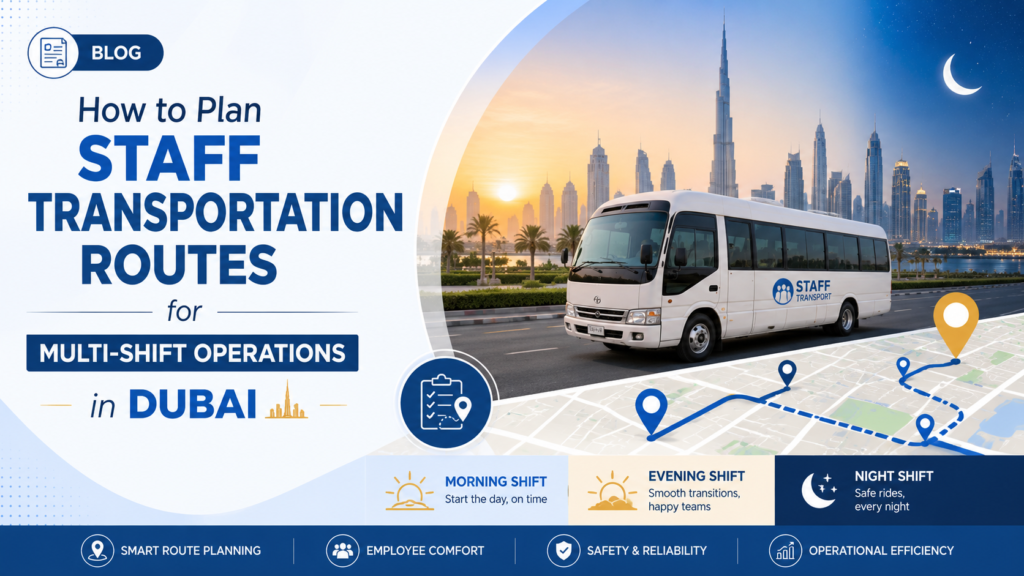
Most companies get this wrong from the start. They spend weeks comparing providers instead of learning how to plan staff transportation routes for multi-shift operations in Dubai. The real work is mapping shift patterns and pickup clusters — that’s what actually builds a good route.
A factory running three shifts needs a different route logic than a nine-to-five office. So does a hospital with staggered start times, or a hotel with a split morning-and-night workforce. Get the planning wrong and you end up with half-empty buses on one leg and overcrowded ones on another. It doesn’t matter how good the employee transport company running the fleet is.
Here’s how HR and operations teams in Dubai, Sharjah and Abu Dhabi usually approach it — and where the planning mistakes happen.
Start With Shift Patterns, Not Headcount
The number of employees matters less than when they need to move. A 120-person single shift needs a completely different fleet than a 120-person three-shift operation. Before you contact any provider, lay out three things:
- Shift start and end times, including any handover overlap
- Whether shifts are fixed or rotate weekly
- Peak days — some sites run lighter on weekends or Fridays
This one input changes everything downstream, from vehicle count to driver rostering. It’s also exactly what a workers transport company will ask for before quoting a firm price.
Map Where Your Staff Actually Live — Not Just Which City
“Most staff live in Sharjah” isn’t specific enough to build a route. What matters is clustering. How many people live within a short walk of a common pickup point? Scattered addresses force a provider into inefficient door-to-door loops. Or they push staff to walk further to a shared stop.
Try this instead: group staff by neighbourhood, not by emirate, before you send the list over. It shortens the planning cycle. It usually cuts the number of vehicles you need, too.
Match Vehicle Size to the Route, Not the Total Headcount
It’s tempting to divide total staff by seats and call it done. But good employee transport in Dubai mixes vehicle sizes within a single shift. Use a smaller vehicle for a tight residential cluster. Use a larger coach for a high-volume corridor. This approach beats standardising on one bus size company-wide, and it keeps staff transport services in Dubai cost-efficient over time.
Build Traffic Windows Into the Schedule, Not Just Distance
Distance on a map is a poor predictor of commute time here. A Sharjah-to-Dubai run and an Ajman-to-Jebel Ali run can look similar in kilometres. But they behave very differently depending on the hour. Abu Dhabi employee transportation faces its own version of this problem, between the city and Mussafah’s industrial zones:
- Early-morning industrial shifts (05:00–06:00) usually clear border roads faster than office-hour departures
- Second-shift and evening pickups often hit return congestion that a straight-line estimate misses
- Night-shift routes stay flexible on timing but need the tightest security and driver-verification checks
Plan around actual traffic windows, not just distance. That’s usually what separates a route sheet that works on paper from one that works every day.
Run a Trial Before You Commit to the Live Schedule
Even a well-planned route sheet has blind spots. A pickup point can be hard to access. A stretch can run longer than expected. A stop might need to move because parking isn’t available. You won’t catch these until buses actually run the route. Run one trial before staff start relying on the service daily. It catches most problems before they become recurring complaints.
Plan for Change From Day One
Staff transportation isn’t a “set once” arrangement. Headcounts shift. New joiners need adding. Shift patterns get revised for a new production line or a seasonal peak. Two things make this easier later:
- A named point of contact on the provider’s side, so route changes don’t get lost in a general inbox
- A defined turnaround time for reissuing an updated route sheet, agreed before you sign
Skip this step at the planning stage, and you’ll likely spend months firefighting small changes afterward.
Frequently Asked Questions
How far in advance should we start planning staff transportation? For a straightforward single-shift setup, a week is usually enough between sending the staff list and going live. Multi-shift or multi-site operations need two to three weeks, mainly to allow for a proper trial run.
Can routes be adjusted after the trial run but before go-live? Yes — that’s the point of running one. Adjustments at this stage cost far less than adjustments after staff have started relying on fixed pickup times.
Do rotating shifts need a completely new route plan each time they change? Not usually. A well-built route sheet is designed around pickup clusters and vehicle capacity. Most rotation changes only need timing adjustments, not a full re-plan.
Should seasonal or project-based staff be included in the same route plan? It depends on volume. Existing routes can often absorb small seasonal increases. Larger project mobilisations usually work better with short-term dedicated vehicles instead of stretching the permanent fleet. This is where staff transportation for rental services in Dubai tends to cost less than expanding a permanent fleet.
Is the planning process different for employee transport in the UAE outside Dubai — say Sharjah or Ajman? The core steps stay the same. But inter-emirate corridors need more buffer time built into the schedule. A route plan that only accounts for in-city traffic will consistently run late once it crosses a border road during peak hours.
Where This Fits With ICR
This is broadly the process ICR follows for every new staff transportation contract: shift mapping, route clustering, a trial run, and a named account manager for changes after go-live. Planning a new site or a shift change? Send over your staff locations and shift times, and we’ll turn it into a route sheet within a working day.