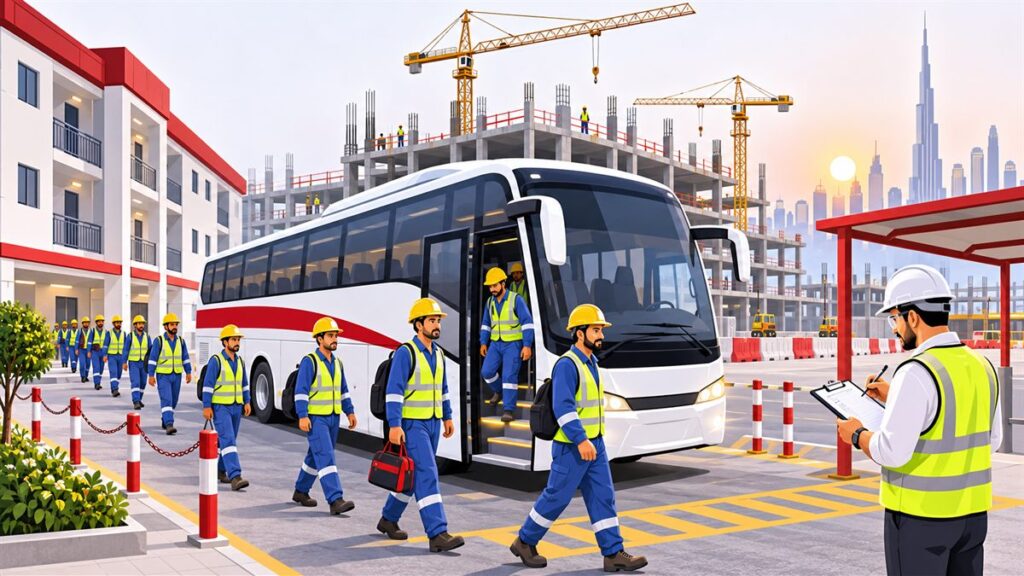
Moving hundreds of workers from accommodation to a construction site every morning is one of the biggest daily operations on any project. If the buses are late, the whole site starts late. This guide explains how to plan camp-to-site transport and what to expect from a workers transport company in Dubai, Sharjah and Abu Dhabi.
What camp-to-site transport means
Camp-to-site transport is the daily movement of workers between labour accommodation and one or more project sites, plus the return trip after the shift. Common accommodation areas include Al Muhaisnah (Sonapur), Al Quoz and Jebel Ali in Dubai, Sajaa in Sharjah and Musaffah in Abu Dhabi.
Unlike office staff transport, it usually means:
- large groups leaving from one or two accommodation buildings
- very early start times
- sites that change as the project moves
- dusty or unpaved access roads at the site gate
Step 1: Map headcount by camp, site and shift
| Information | Why it matters |
|---|---|
| Workers per accommodation building | Decides how many buses start from each pickup point |
| Workers per site and per shift | Decides bus size and number of trips |
| Shift start and end times | Sets departure times and driver hours |
| Overtime and weekend work | Decides if you need extra trips |
| Expected headcount changes | Lets you add buses before the next project phase |
Keep this sheet updated every week. Headcount on construction projects changes fast.
Step 2: Choose the right bus size
- 84-seater buses for big crews from one camp to one site.
- Large AC buses (around 35–67 seats) for mid-size crews or when access roads are tight.
- Coasters (around 22–30 seats) for small crews, supervisors or second sites.
See our guide Hiace vs Coaster vs 84-Seater for a full comparison.
Step 3: Plan timings around the shift and the heat
- Allow buffer for traffic, gate checks and boarding.
- Plan the return trip for the real finish time, including overtime.
- During the UAE’s summer midday break for outdoor work (usually mid-June to mid-September; confirm MoHRE’s dates each year), shift patterns change. Adjust bus timings when the shift pattern changes.
- Make sure the AC works on every bus, every day.
Step 4: Check site access before day one
- Is there space for a large bus to stop and turn?
- Is there a safe drop-off point away from machinery and site traffic?
- Do drivers need a gate pass or a site induction?
- Who on site receives the bus and checks the headcount?
Step 5: Safety rules on every trip
- One seat per worker; never more passengers than the licensed seating capacity.
- Boarding and drop-off only at agreed safe points.
- Experienced drivers who know the route and the site rules.
- Clean, maintained, air-conditioned buses with a first aid kit and fire extinguisher.
- A clear process for breakdowns, delays and replacement buses.
More detail: Labour Transportation Safety in UAE: A Guide for Employers.
Step 6: Agree the contract terms with your workers transport company
- Monthly or project-long contract, and the notice period to add or remove buses
- Number of trips per day and what happens with overtime trips
- Replacement bus time if a bus breaks down
- Who pays fuel, Salik and parking
- One contact person on each side for daily issues
Before signing, read What to Check Before Hiring a Labour Transport Company in UAE.
Common mistakes to avoid
- Planning by total headcount instead of per shift.
- Ignoring site changes as the project moves.
- No backup plan for breakdowns.
- Choosing buses that are too big for the site access road.
- No single person responsible for transport on the site.
How New Arabian Passengers Transport can help
New Arabian Passengers Transport by Rented Buses LLC provides labour transportation services with Coasters, TATA and AC buses up to 84 seats, with drivers, on daily, monthly and long-term contracts across Dubai, Sharjah and Abu Dhabi. We also run staff transportation for office and site teams.
Send us your camps, sites, headcount and shift timings and we will suggest a bus plan. Contact us, call +971 54 728 1844 or WhatsApp +971 55 399 8199.
FAQs
What size bus is best for camp-to-site transport?
For large crews from one camp to one site, an 84-seater or large bus is usually the most practical. For small crews or several sites, Coasters give more flexibility.
Can the bus schedule change when our shift timings change?
Yes. On monthly contracts, timings are usually updated when the project changes shift patterns, for example during the summer midday break.
What happens if a bus breaks down on the way to site?
Agree a replacement time in the contract and make sure the transport company has backup vehicles.
Can one contract cover more than one site?
Yes. Many projects run several buses from one or more camps to different sites under one contract.