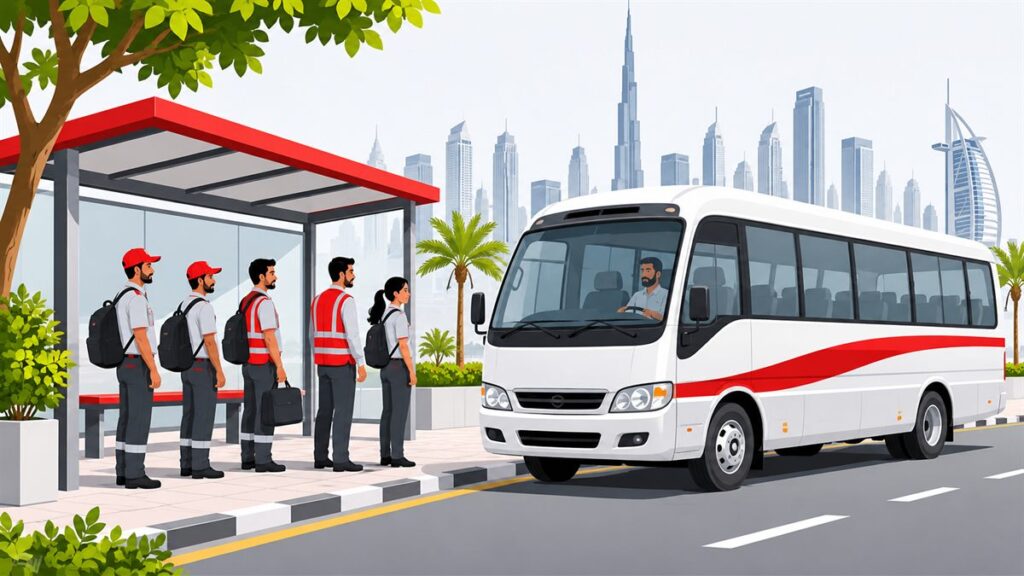
Most staff transport problems do not start on the road. They start at the kerb. A badly chosen pick-up point means late departures, crowded pavements, employees crossing busy roads and drivers stopping where they should not. Good staff pick-up points are the cheapest improvement an HR or facility manager in Dubai can make to an employee transport programme, and they cost nothing except planning time.
This guide explains how to choose, test and document safe stops for staff buses, whether employees live in company accommodation or in private homes across the city.
Why pick-up point planning matters
A bus that serves 30 or 50 employees may stop at several points before reaching the workplace. Every stop adds time, and every poorly placed stop adds risk. Planned properly, pick-up points:
- keep the route predictable so employees arrive on time
- reduce the chance of people running or crossing roads to catch the bus
- avoid conflict with residents, security staff and other traffic
- make it easier to check attendance and headcount
Criteria for a safe staff bus stop
Before you approve a location, walk it at the actual pick-up time, not at midday. Check the following.
- Space for the vehicle: a Hiace needs far less room than a 50-seater or 84-seater bus. Confirm the exact vehicle size that will use the stop.
- Legal stopping: the bus should stop only where stopping is permitted, outside no-stopping zones, junction corners and bus lanes used by public transport.
- Visibility: the driver and the waiting employees should be able to see each other clearly, including in early morning or evening light.
- Safe waiting area: employees should wait on a pavement or inside a compound, not at the edge of a live traffic lane.
- No road crossing: where possible, place the stop on the side of the road where most employees live.
- Shade and shelter: in summer heat, a shaded spot makes a real difference to staff comfort.
- Lighting: essential for early morning and night-shift pick-ups.
Stop planning for staff living in accommodation versus private homes
The right approach depends on where your employees live.
| Situation | Recommended approach |
|---|---|
| Company or labour accommodation | One pick-up point inside or directly at the accommodation gate, agreed with the building management |
| Employees spread across one neighbourhood | A few fixed, well-spaced stops at recognised landmarks |
| Employees spread across several emirates | Hub stops on main corridors, such as a Sharjah to Dubai route, with employees travelling a short distance to reach them |
As a rule, fewer and better stops beat many convenient ones. Every extra stop adds minutes for every employee already on board.
Step-by-step: how to set up pick-up points
- Map where employees live. Collect residential areas, not exact addresses, and group them into clusters.
- Shortlist candidate stops near each cluster: a mosque car park, a supermarket entrance, a compound gate or a wide service road.
- Visit each location at the real pick-up time and note traffic, parking, lighting and who else uses the space.
- Get permission where the stop is on private land, such as a mall car park or residential compound.
- Agree the timing with your transport provider, including how long the bus waits at each stop.
- Share a simple stop list with employees: name, landmark, pick-up time and a contact number.
- Review after two weeks using real boarding and delay data, then adjust.
Timing, waiting rules and headcount
Decide the rules before launch and put them in writing:
- how long the bus waits at each stop before moving on
- what happens when an employee misses the bus
- who records attendance, the driver, a supervisor or the employee through a simple list
- how employees report a problem with a stop
Hypothetical example: a company with 40 employees living in the same area initially uses five stops and finds the bus spends more time stopped than driving. After a review, it merges them into two clearly marked stops at wide, well-lit locations, and the route becomes shorter and easier to run. The numbers are illustrative only, but the pattern is common.
Special cases to plan for
- Night shifts: choose well-lit stops and avoid isolated locations. See our guide on night shift staff transport for more.
- Female employees: prioritise stops in busy, well-lit, visible areas and consider the walking distance from home.
- Heat and weather: shaded stops and short waiting times matter most in summer.
- Industrial zones: at drop-off points such as JAFZA, Al Quoz or DIP, agree a clear entrance and exit point so the bus does not block gate traffic.
Common mistakes to avoid
- choosing stops from a map without visiting them
- using the same stop for different vehicle sizes without checking space
- letting employees change stops informally, which breaks the schedule
- never reviewing the stops after the first week
Frequently asked questions
How many pick-up points should a staff bus have?
There is no fixed number. As a general guide, keep stops to what the schedule can absorb. Fewer stops mean a faster route, so use the minimum that keeps walking distances reasonable.
Can a staff bus stop outside any building?
No. Buses should stop only in permitted places. Check the local rules and, for private land, get permission from the owner or building management.
Who decides the pick-up points, the company or the transport provider?
Best results come from working together. The company knows where employees live, and the transport provider knows the vehicle size, driver timing and road conditions.
How often should pick-up points be reviewed?
Review them after the first two weeks, then whenever headcount, shifts or accommodation change.
How New Arabian Passengers Transport can help
We provide staff transportation with drivers in Dubai, Sharjah and Abu Dhabi, using vehicles from 15 to 84 seats on daily, monthly and long-term contracts. Our team can help you plan stops and timings that suit your vehicles and shifts.
- Staff transportation
- Labour transportation
- Contact us for a quote
- Call us on +971 54 728 1844
- Message us on WhatsApp
Pingback: Staff Transport RFQ Template for UAE Companies