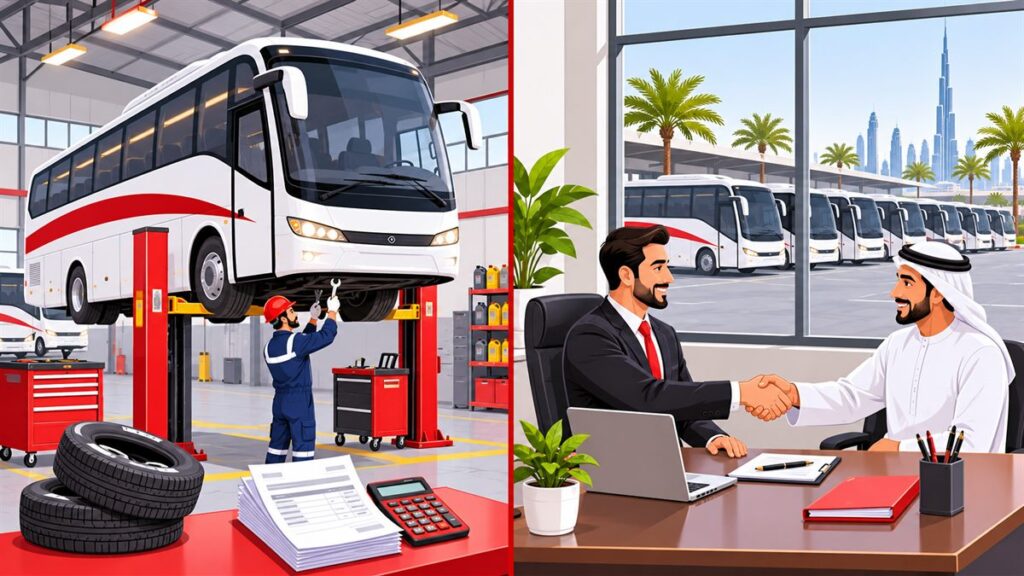
Every UAE company with a workforce to move reaches the same decision sooner or later: buy and run your own buses, or outsource employee transport to a specialist. Choosing between outsourcing vs owning a company bus fleet in the UAE is less about the sticker price of a bus and more about everything that surrounds it: drivers, permits, maintenance, replacements, insurance and the management time all of that consumes. This guide gives HR, admin and facility managers a practical way to compare both options.
What owning a company bus fleet really involves
Owning looks simple at first: buy a few buses, hire drivers, and the commute is under your control. In practice the company becomes a small transport operator. You are responsible for:
- Vehicles: purchase or financing, registration, renewal and keeping each bus suitable for its licensed seating capacity.
- Drivers: recruitment, valid licences, visas, accommodation, supervision and cover for leave or sickness.
- Maintenance: scheduled servicing, tyres, air-conditioning repairs and downtime while a bus is in the workshop.
- Compliance: valid permits, insurance and inspections, tracked by someone with the time to do it.
- Operations: routes, rosters, fuel control, incident handling and complaints from employees.
None of this is impossible, but it needs dedicated people and process. For a company whose core business is not transport, that attention is often taken from something else.
What outsourcing employee transport means
With outsourcing, a transport company supplies the buses and the drivers under a contract, usually daily, monthly or long-term. The provider handles vehicle upkeep, driver management and replacements, while you define routes, timings and headcount. You keep control of the service through the contract and regular review, without owning the assets.
Outsourcing vs owning: a side-by-side comparison
| Factor | Owning a fleet | Outsourcing |
|---|---|---|
| Upfront commitment | Significant capital or financing | Contract-based, no vehicle purchase |
| Breakdown cover | You must arrange a replacement | Typically a provider responsibility, confirm in the contract |
| Driver management | Fully yours | Provider-managed |
| Flexibility when headcount changes | Low, buses are fixed assets | Higher, vehicle size and number can be reviewed |
| Control over daily operations | Maximum | Shared, set through the contract |
| Admin workload | High | Lower, mostly contract and service review |
Questions to answer before you decide
- How stable is your headcount? If staff numbers, shifts or sites change often, fixed buses can sit half empty or leave people stranded.
- Do you have transport expertise in-house? Without a transport coordinator, problems tend to surface only when employees complain.
- How critical is punctuality? Ask what happens on the day a bus or driver is unavailable, and who arranges the replacement.
- What is the true total cost? Add vehicles, driver costs, fuel, maintenance, insurance, permits and management time, then compare it with the contract quotes you receive.
- How long is the planning horizon? Long, stable routes can favour ownership; changing needs often favour a contract.
Hypothetical example
Hypothetical example: a logistics company with two warehouses has 120 staff on two shifts. One warehouse closes after a year and the team is merged. Owned buses sized for the old routes are now surplus, while a contract could have been adjusted to a smaller number of vehicles. A different company with a fixed single site and steady headcount might find ownership more predictable. The right answer depends on your own numbers.
A simple way to compare costs fairly
- List every cost of owning for one year, including the hidden ones such as replacement vehicles and downtime.
- Request written quotes from outsourcing providers for the same routes, shifts and seat requirements.
- Compare cost per employee per month, not just cost per bus.
- Check what each quote includes: driver, fuel, replacement bus and supervision.
For help choosing the right vehicle size under either option, see our guide on staff transport bus sizes.
When a hybrid approach makes sense
Some companies keep a small owned fleet for core, predictable routes and outsource peak-period or overflow capacity, such as extra shifts, temporary projects or events. This gives control where it matters and flexibility everywhere else. Before committing to it, define clearly who is responsible for each route.
How New Arabian Passengers Transport can help
New Arabian Passengers Transport by Rented Buses LLC provides buses with drivers in Dubai, Sharjah and Abu Dhabi, from 15 to 84 seats, on daily, monthly and long-term contracts. Learn more about our staff transportation, labour transportation and passenger transportation services, or contact us to discuss your routes. You can also call +971 54 728 1844 or message us on WhatsApp.
Frequently asked questions
Is outsourcing staff transport always cheaper than owning buses?
Not always. It depends on your routes, headcount stability and how well you manage an owned fleet. Compare full annual costs with written quotes rather than assuming.
Who handles a breakdown under an outsourced contract?
This should be written into the contract. Ask specifically about replacement vehicles and response expectations before signing.
Can we start with a short contract and extend later?
Many companies begin with a daily or monthly arrangement to test routes and then move to a longer contract. Discuss options with your provider.
Can we outsource only some routes?
Yes. A hybrid model, with some routes owned and others outsourced, is a common approach for companies with mixed needs.